The Systematic Slaughter
How Islamic Terror Groups Are Orchestrating a Silent Genocide Against African Christians

The blood of Christian martyrs has soaked deep into African soil. From the dusty villages of Nigeria to the dense forests of the Democratic Republic of Congo, a deliberate campaign of religious extermination is unfolding with horrifying precision. What the international community has largely ignored or dismissed as “ethnic conflict” is, in reality, a coordinated Islamic jihad designed to obliterate Christianity from the African continent.
The statistics tell a story that would make genocidal dictators of the past envious. In Nigeria alone, over 7,000 Christians were slaughtered in just the first seven months of 2025, an average of 32 murders every single day. That’s more than one Christian killed every hour of every day. But these aren’t just numbers on a government report; these are fathers gunned down while protecting their families, mothers hacked to death with machetes while clutching their infants, and children beheaded simply for bearing the name of Christ.
The orchestrators of this carnage aren’t random criminals or desperate bandits. They are highly organized Islamic terror networks operating with military precision across multiple countries. These groups share ideology, resources, and most importantly, a singular goal: the complete eradication of Christianity from Africa.
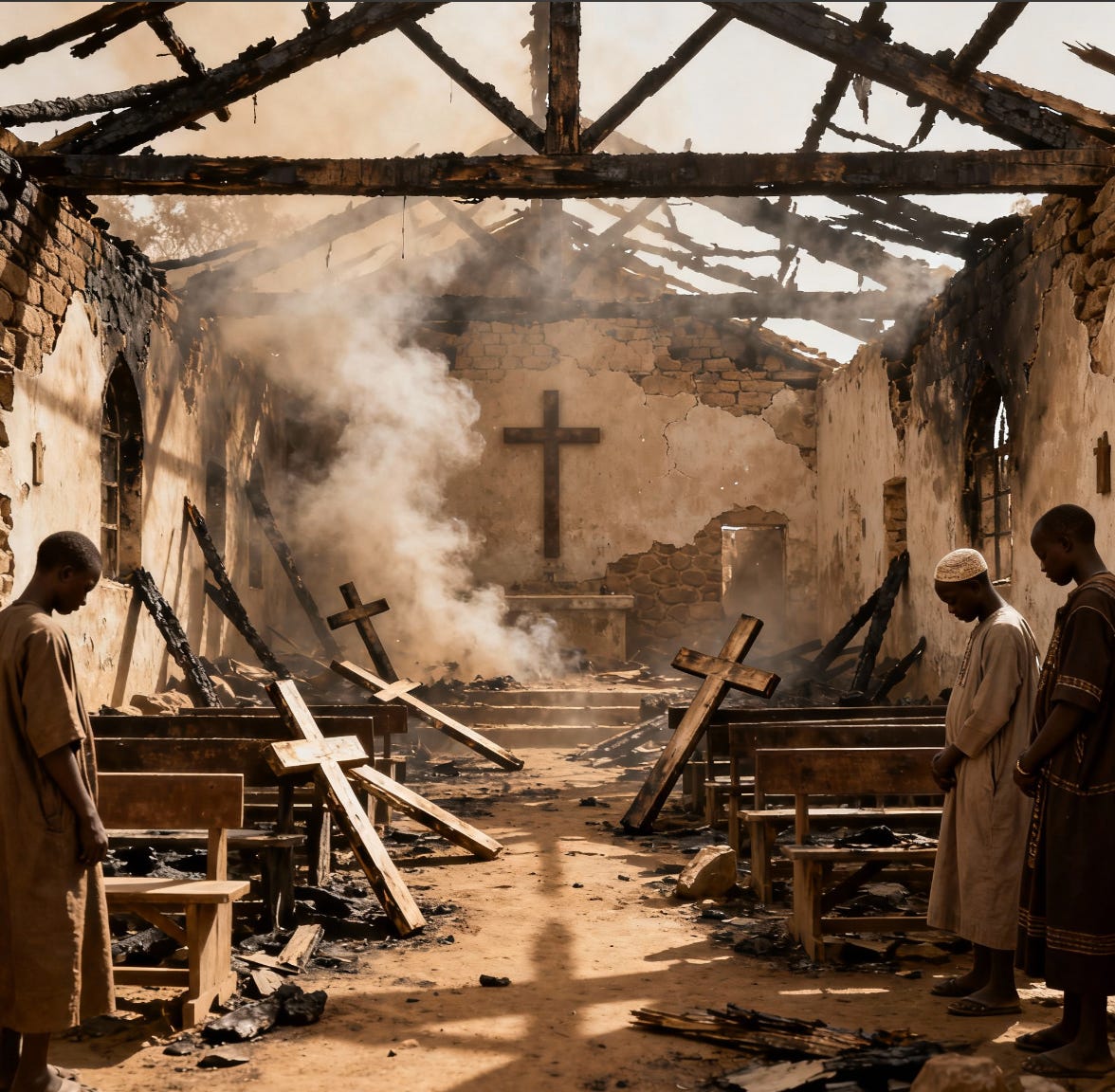
The Architects of Terror: Meet Nigeria’s Islamic Death Squads
Nigeria has become the epicenter of anti-Christian violence, serving as headquarters for at least 22 distinct Islamic terror groups. At the forefront stands Boko Haram, whose very name translates to “Western education is forbidden”, a declaration of war against the Christian educational and cultural foundations that have shaped Nigerian society for generations.
Since 2009, Boko Haram has systematically targeted Christian communities with the methodical thoroughness of a military campaign. Their tactics are as barbaric as they are effective: entire villages surrounded at night, Christians separated from Muslims through forced religious recitation, and mass executions carried out with AK-47s and machetes. Those who can recite verses from the Quran are released; those who cannot are murdered on the spot.
Working alongside Boko Haram are their equally vicious allies: the Islamic State West Africa Province (ISWAP), which split from Boko Haram in 2016 to align directly with ISIS leadership in Syria. ISWAP has proven even more ruthless than their parent organization, specializing in the targeted assassination of Christian clergy and the systematic destruction of church infrastructure.
But perhaps the most insidious threat comes from the Fulani jihadists, militant herdsmen who have weaponized ancient pastoral traditions into modern religious warfare. Unlike other terror groups that operate from remote hideouts, Fulani militants embed themselves within legitimate herding communities, using cattle grazing as cover for reconnaissance and attack planning. They strike Christian farming villages with devastating effectiveness, often timing their assaults to coincide with harvest seasons to maximize economic destruction alongside human casualties.
The Fulani jihadists have perfected a particularly brutal form of psychological warfare. They don’t simply kill, they torture. Victims are often found with deep machete wounds to the back of the neck, a signature killing method that has become their calling card. Women are gang-raped before execution, children are burned alive in their family homes, and Christian religious leaders are specifically targeted for prolonged torture before death.
The Yelwata Massacre: 280 Christians Slaughtered in a Single Night
On the night of June 13-14, 2025, the village of Yelwata in Benue State became ground zero for one of the most horrific Christian massacres in recent history. This predominantly Catholic farming community, 97% Catholic, 3% Protestant, had served as a sanctuary for internally displaced persons fleeing previous Islamic attacks. It was precisely this concentration of Christian refugees that made Yelwata an irresistible target for Fulani jihadists.
Over 40 gunmen arrived on motorcycles just after 10 PM, surrounding the village in a coordinated assault that demonstrated sophisticated military planning. Survivors reported hearing the terrorists shouting “Allahu Akbar” as they moved methodically from house to house, executing residents and setting homes ablaze.
The killers showed no mercy for age or gender. Infants were ripped from their mothers’ arms and thrown into burning buildings. Elderly Christians too weak to flee were hacked to death in their beds. Pregnant women had their stomachs sliced open, their unborn children murdered alongside them. The terrorists specifically targeted the village’s small Catholic church, where they murdered anyone found praying or seeking sanctuary.
“We’re still finding bodies in the bushes,” reported Mton Matthias, a local youth leader who witnessed the aftermath. “The death toll is rising every hour.” Hope Faith Ori, a data officer with the Catholic Diocese of Makurdi, confirmed that over 150 bodies had been recovered within the first 48 hours, with many more presumed dead but still missing.
The scale of the Yelwata massacre was unprecedented, but it was not isolated. It represented the culmination of a coordinated campaign across Benue State that had been building for months. Earlier attacks in May and June had systematically targeted Christian communities throughout the region: Aondoana in Gwer-West County, Edikwu-Ankpali in Apa County, and Akundu-Tyough in the state capital of Makurdi itself.
Kenya’s Christian Martyrs: Al-Shabaab’s Religious Inquisition
Six hundred miles to the east, Kenya has become another theater of Islamic terror against Christians, with the Somalia-based Al-Shabaab movement leading the charge. Al-Shabaab, which pledges allegiance to Al-Qaeda, has refined the art of religious targeting to a chilling science.
Their methodology is as systematic as it is savage. When Al-Shabaab militants attack buses, workplaces, or communities, they immediately separate Christians from Muslims through a process that resembles a medieval religious inquisition. Victims are forced to recite verses from the Quran or answer detailed questions about Islamic theology. Those who demonstrate insufficient knowledge of Islam are presumed to be Christian and marked for execution.
The case of six Kenyan Christian merchants in April 2024 illustrates this targeting with devastating clarity. Joseph Githonga and Simon Karimi from the East Africa Pentecostal Church, Peter Muthuri and Thomas Muthee from Kenya Assemblies of God, and James Mwendwa and John Kathure from the Anglican Church had been conducting business in the Somali border town of Dhobley for six years. But their real mission was evangelization, sharing their Christian faith with local Muslims and conducting evening prayer meetings.
When Al-Shabaab discovered that several Muslims had been secretly attending these Christian gatherings, they acted swiftly. Four hooded militants arrived in a Toyota Probux at dawn, surrounding the Christians’ shops and living quarters. Each man was shot at close range, their businesses set ablaze as a warning to any other Christians who might dare to share their faith in Islamic territory.
The Garissa University College attack of April 2, 2015, demonstrated Al-Shabaab’s capability for mass casualty religious targeting. The terrorists separated Christian students from their Muslim classmates, then systematically executed 148 Christians in what amounted to an educational institution-based religious cleansing operation.
The DRC Horror: ISIS-Affiliated Butchers Target Church Sanctuaries
In the eastern Democratic Republic of Congo, the Allied Democratic Forces (ADF) have transformed Christian persecution into an art form of unimaginable brutality. This Ugandan-originated group pledged allegiance to ISIS in 2019, adopting the caliphate’s signature tactics of mass execution and religious targeting while adding their own innovations in terror.
The Komanda church massacre of July 27, 2025, reveals the ADF’s tactical evolution and their particular hatred for Christian worship. Catholic youth participating in a summer prayer retreat were gathered for a night vigil when ADF militants surrounded the church compound at 1 AM. What followed was a methodical slaughter that left 49 Christians dead, including nine children who were beheaded with machetes.
Judith, an Open Doors church partner who arrived at the scene hours after the attack, described a landscape of horror that defied comprehension. “Attackers came in and they beheaded Christians in the church. The jihadis killed those they met in the church hall. Those who tried to flee, they caught them and killed them in the compound. And then some others who managed to run towards the road, those also were caught and killed. All of them were killed with machetes.”
The terrorists’ brutality extended beyond mere killing. Children who weren’t immediately murdered were abducted for forced recruitment as child soldiers. Young girls were separated for sexual slavery. The church building itself was desecrated, with crosses torn down and Christian symbols destroyed. Nearby shops and homes were systematically looted and burned, ensuring that survivors would have no means of rebuilding their community.
But Komanda was just the beginning of a weekend of terror. The same ADF cell proceeded to Machongani, where they killed four more Christians and set additional homes ablaze. In Ngeleza, 13 kilometers from Komanda, they ambushed two Christians and their driver, murdering them with machetes before burning their bodies and destroying their motorcycle.
The February 13, 2025, Mayba massacre demonstrated the ADF’s increasing sophistication in Christian targeting. Militants conducted a door-to-door operation at 4 AM, systematically identifying and capturing Christians throughout the village. “Militants went door by door saying, ‘Get out, get out and don’t make any noise,’” reported a church elder from a nearby town. Twenty Christians were initially captured and tied up, but when the rest of the Christian community attempted a rescue operation, ADF fighters surrounded the entire village and captured 50 additional believers.
All 70 Christians were then marched to a Protestant church in Kasanga, where they were murdered inside the sanctuary with machetes and hammers—a deliberate act of religious desecration that transformed a house of worship into a slaughterhouse. The symbolic significance was unmistakable: Christian churches would become graveyards for Christian believers.
The Military Precision of Religious Genocide
What makes these attacks particularly terrifying is their level of organization and coordination. These are not spontaneous outbursts of religious hatred—they are carefully planned military operations designed to maximize Christian casualties while minimizing Islamic losses.
Intelligence gathering precedes every major attack. In Yelwata, the Fulani jihadists had conducted reconnaissance for weeks, identifying the village’s role as a Christian refuge center and mapping escape routes to prevent survivors from reaching safety. In Kenya, Al-Shabaab maintains extensive networks of informants who identify Christian businesses, schools, and gathering places for future targeting.
The timing of attacks is equally strategic. Many occur during Christian religious observances when believers are concentrated in vulnerable locations. The Komanda massacre targeted Catholics during a prayer retreat. The Yelwata attack occurred when many families were gathered for evening meals. Nigerian churches have been specifically targeted during Sunday services, Christmas celebrations, and Easter gatherings.
Weaponry selection also reveals military-level planning. AK-47 assault rifles provide the firepower necessary to overcome local security forces, while machetes and bladed weapons are employed for their psychological impact and to ensure silent kills when necessary. The combination creates maximum terror while minimizing the operational risks that might come with more sophisticated weaponry.
Communication between terror cells has enabled coordinated multi-front campaigns. The Alliance for Jihad in Nigeria, formed in June 2020, represents a formal confederation of Islamic terror groups sharing intelligence, resources, and tactical coordination. This allows for simultaneous attacks across multiple states, overwhelming security responses and creating the impression of Islamic dominance across vast territories.
The Systematic Destruction of Christian Infrastructure
Beyond the murder of individual Christians lies a comprehensive campaign to eliminate the physical infrastructure of Christian civilization in Africa. Nigerian Islamic terrorists have destroyed over 19,100 churches since 2009, an average of more than three churches demolished, burned, or violently closed every single day for the past 15 years.
This represents far more than random destruction. It constitutes a systematic effort to erase Christianity’s physical presence from the African landscape. Churches serve as community centers, schools, medical clinics, and cultural preservation sites. Their destruction eliminates not just places of worship but the entire social infrastructure that sustains Christian communities.
The economic impact is equally devastating. Christian farmers have been driven from their ancestral lands, creating food shortages and economic instability that ripples through entire regions. In Nigeria’s Middle Belt, formerly productive agricultural areas have been abandoned as Christian farmers flee for their lives, leaving behind thousands of square miles of fertile farmland that is then occupied by Fulani herders.
Educational institutions receive particular attention from Islamic terrorists. Christian schools are viewed as centers of “Western” influence that must be eliminated. Boko Haram’s very name reflects this ideology, and their systematic targeting of educational facilities has crippled Christian intellectual development across vast regions of Africa.
Healthcare facilities operated by Christian organizations have also become primary targets. Hospitals, clinics, and medical training centers established by Christian missionaries and denominations represent vital infrastructure in regions where government healthcare services are minimal or nonexistent. Their destruction eliminates medical care for both Christian and Muslim populations, creating humanitarian crises that serve the terrorists’ broader destabilization objectives.
The International Community’s Deafening Silence
Perhaps the most disturbing aspect of this unfolding genocide is the international community’s systematic refusal to acknowledge its religious dimension. Western governments, international organizations, and mainstream media outlets consistently describe these attacks as “ethnic conflict,” “resource competition,” or “climate-driven violence”, anything except what they actually are: religious persecution and attempted genocide.
This deliberate mischaracterization serves multiple political purposes. Acknowledging anti-Christian genocide would require military intervention under international law, something Western powers are reluctant to undertake in Africa. It would also contradict multiculturalist narratives that present Islam as inherently peaceful and Christianity as historically oppressive.
The United Nations has been particularly complicit in this cover-up. Despite overwhelming documentation of systematic religious targeting, UN reports consistently avoid religious terminology, instead describing attacks as “communal violence” or “resource conflicts.” This linguistic manipulation provides political cover for member nations who prefer not to confront Islamic terrorism directly.
European governments, many dealing with their own Islamic integration challenges, have shown little appetite for defending African Christians. The same political leaders who express outrage over antisemitic incidents in their own countries remain silent when Christians are beheaded in African churches. The hypocrisy is as obvious as it is morally reprehensible.
American response has been marginally better, with some Congressional representatives and religious freedom organizations documenting and condemning the persecution. However, broader American foreign policy continues to prioritize stability over religious liberty, often supporting African governments that are unwilling or unable to protect their Christian populations.
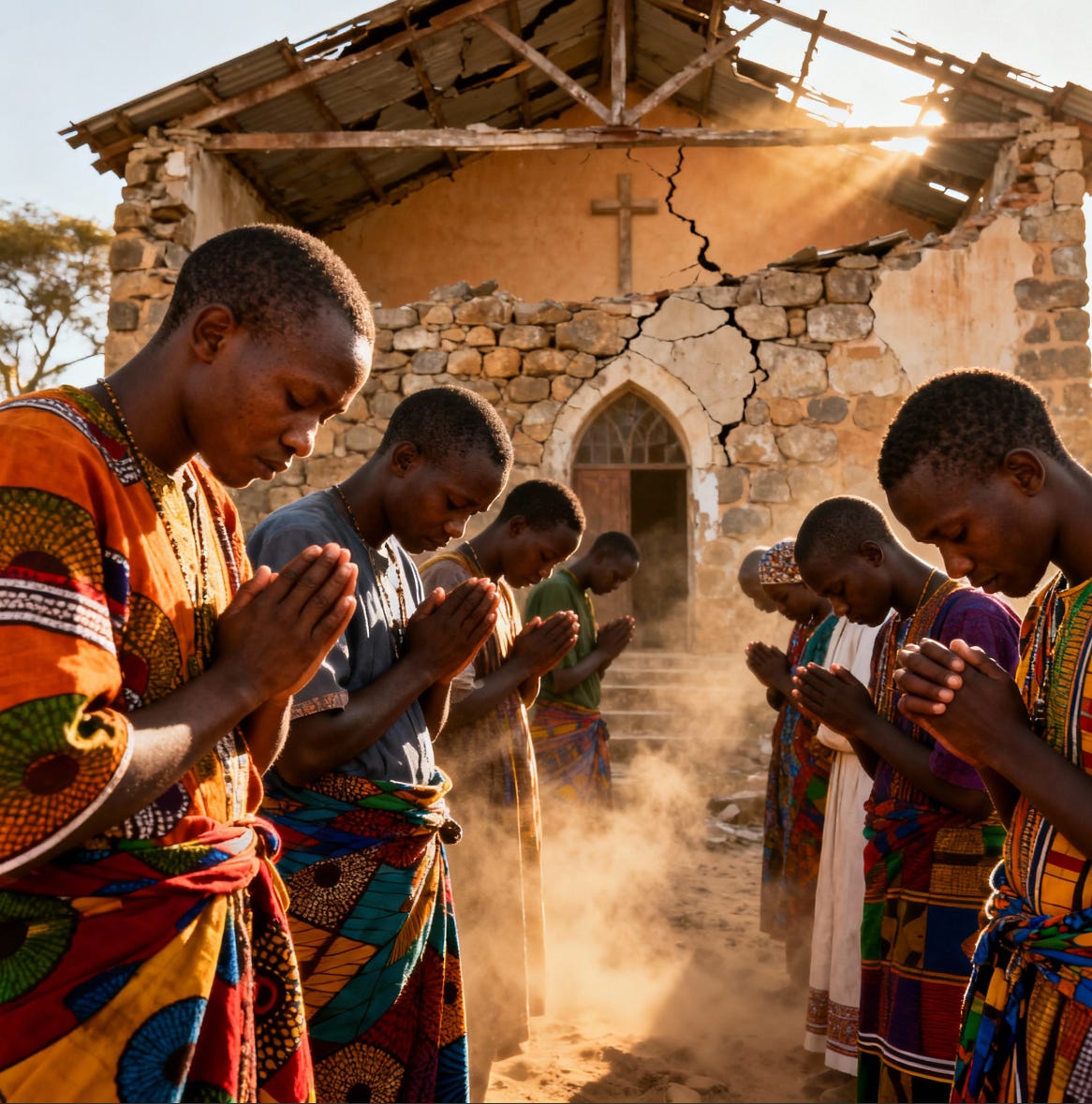
The Stakes: Christianity’s Existential Battle for Africa
What is happening in Nigeria, Kenya, the Democratic Republic of Congo, and across sub-Saharan Africa represents nothing less than an existential battle for the future of Christianity on the African continent. The stated goal of organizations like Boko Haram is to establish Islamic caliphates where Christianity will be banned and practicing Christians will face death or conversion.
This is not hyperbole or exaggeration. Islamic terrorists have explicitly declared their intention to eliminate Christianity from Africa within the next 50 years. Their methodology, systematic murder, infrastructure destruction, economic warfare, and psychological terror, represents a comprehensive strategy designed to make Christian life impossible across vast regions of the continent.
The historical parallels are unmistakable. What is occurring in modern Africa mirrors the Islamic conquests that eliminated Christianity from North Africa and the Middle East over a millennium ago. Christian communities that had existed since the time of the apostles were systematically destroyed through campaigns of murder, forced conversion, and cultural elimination. The result was the virtual extinction of Christianity across regions where it had once flourished.
The same dynamic is now unfolding in sub-Saharan Africa, where Christianity represents the world’s fastest-growing religious population. Africa’s Christian population has exploded from approximately 10 million in 1900 to over 600 million today, with projections suggesting it could reach 1 billion by 2050. This explosive growth has made Africa the new epicenter of global Christianity, surpassing Europe and North America in both numbers and spiritual vitality.
It is precisely this Christian revival that Islamic terrorists seek to crush before it becomes unstoppable. They understand that Africa’s Christian awakening represents an existential threat to Islamic expansion across the continent. If Christianity continues its current growth trajectory, it will become the dominant religious force in Africa within a generation.
The Economic Jihad: Strangling Christian Communities Through Systematic Impoverishment
Beyond the immediate violence lies a comprehensive economic warfare campaign designed to make Christian life economically unsustainable across wide regions of Africa. This economic jihad operates through multiple vectors, each designed to strangle Christian communities slowly while avoiding the international attention that mass killings might attract.
Agricultural warfare represents the most systematic component of this economic assault. Fulani jihadists don’t simply kill Christian farmers, they destroy their ability to generate income through agriculture. Crops are systematically destroyed during planting seasons to prevent harvest. Livestock are stolen or slaughtered, eliminating both food sources and economic capital. Water sources are poisoned or blocked, making both human survival and agricultural production impossible.
The timing of these agricultural attacks demonstrates sophisticated understanding of rural economics. Assaults frequently occur during planting season, ensuring that even if farmers survive the immediate attack, they will face starvation during the following harvest season. This creates a cycle of dependency that forces Christian communities to choose between slow starvation and geographic relocation.
Transportation terrorism represents another critical component of economic warfare. Christian traders, merchants, and travelers are systematically targeted on highways and transportation routes, making commercial activity extremely dangerous for Christians. The psychological impact extends far beyond the immediate victims, entire Christian communities become economically isolated when travel for trade becomes potentially fatal.
The kidnapping industry has evolved into perhaps the most sophisticated component of economic warfare against Christians. Rather than simply killing Christian community leaders, terrorists now abduct them and demand enormous ransoms that drain entire communities of their economic resources. Between July 2023 and June 2024, hostage-takers demanded over $32 million in ransom payments for 7,568 abducted individuals. Christian communities, driven by religious obligation to protect their members, often bankrupt themselves paying these ransoms.
Women and Children: The Preferred Targets of Islamic Terror
Among the most disturbing aspects of this systematic persecution is the deliberate targeting of Christian women and children, who suffer disproportionately from Islamic terrorist violence. This targeting is not incidental or collateral, it represents a calculated strategy designed to destroy Christian demographic sustainability while maximizing psychological impact on surviving Christian communities.
Sexual violence against Christian women has become a signature tactic of Islamic terrorist organizations across Africa. Fulani jihadists routinely engage in mass rape of Christian women before execution, with survivors often forced to witness the sexual assault of their daughters and mothers. The March 24, 2025, abduction of a 19-year-old Christian woman in Plateau State, who was gang-raped for four consecutive days, represents a typical case rather than an exceptional incident.
The strategic purpose of systematic rape extends beyond immediate brutalization. In traditional African societies, rape carries enormous social stigma that can make it impossible for victims to reintegrate into their communities. By systematically raping Christian women, Islamic terrorists create long-term social disruption that extends far beyond the immediate violence. Families are torn apart, marriage prospects are destroyed, and entire social networks are destabilized.
Child targeting reveals even more sinister strategic thinking. Christian children represent the future demographic foundation of African Christianity. By systematically murdering Christian children while kidnapping them for forced conversion and military recruitment, Islamic terrorists simultaneously eliminate future Christian population growth while expanding their own operational capacity.
The Boko Haram kidnapping of 276 schoolgirls from Chibok in 2014 exemplified this strategy. These Christian girls were not simply abducted for ransom, they were forced to convert to Islam, given as wives to Boko Haram fighters, and used as breeding stock to produce the next generation of Islamic militants. This represents demographic warfare at its most calculated and evil.
Child soldiers recruited from kidnapped Christian children serve multiple terrorist objectives. They provide immediate military manpower for continued operations. They eliminate future Christian leadership by corrupting potential Christian community leaders while they are young and impressionable. They create psychological warfare advantages by forcing Christian communities to potentially fight against their own kidnapped children.
The deliberate targeting of pregnant Christian women reveals the comprehensive nature of demographic warfare being waged against African Christians. Terrorists don’t simply kill pregnant women, they cut open their stomachs and murder their unborn children, ensuring maximum psychological impact while eliminating future Christian births. This represents genocide in its most literal and comprehensive form.
Educational targeting of Christian children serves broader strategic purposes beyond immediate violence. By destroying Christian schools and kidnapping or killing Christian students, terrorists eliminate the educational infrastructure necessary for Christian community leadership development. This ensures long-term intellectual and leadership deficits that will cripple Christian communities for generations.
The international community’s failure to adequately address violence against Christian women and children represents moral cowardice of the highest order. The same international organizations that express outrage over violence against women in other contexts remain largely silent when Christian women are systematically raped and murdered across Africa.